Herzlich Willkommen
Demonstrations play a central role in Berlin’s lefty scene and, while numerous before, they grew in frequency following their brief ban and heavy restrictions during the start of the COVID-19 pandemic. From normie progressives to nearly all corners of the milieu we call the radical left, they are a go-to political action. There are several lefty or radical demos per week, sometimes multiple per day, sometimes even aligned but in direct competition for attention with one another. There are collectives that exist with an explicit or de facto purpose of putting on demos. There are groups that report on the goings-on of demos. There are structures to support them legally, medically, and psychologically. A great amount of machinery has been built up to make them happen.
Yet for all the flurry of activity around them, can we really say that our frequent demos have helped us move toward liberation?
Social movements rise and fall, and we’re currently in a lull as Palestine fades from public notice as we cross the three year mark since the attacks of October 7th and Israel’s reprisals. The fervor in which we acted in the first years has decreased, and those who’ve stuck around have a chance now to grow before the next wave of social unrest arrives, whatever that might be.
Beyond the Palestine focus, there’s been shifts in all types of demos. The anarchist, antifascist, and autonomist demonstrations are less frequent than they used to be. They’re smaller in size, and they’re less intense, militant, and confrontational despite (or is it because of?) the increasing number of threats we face from the climate crisis, precarity, and rising fascism. Demos are not as they once were, and not for the better.
So then, let’s take a moment to look at what role demonstrations have within our movements. We invest massive amounts of time and energy into them, but what are we actually doing?
The answers are not as obvious as we assume.
Form and Function
We are exceedingly efficient at churning out mass protests according to the typical formula. This formula is used as a blanket approach for dealing with many social issues, and you’ve surely been to one such demo yourself. It goes something like this:
A collective decides to organize a demo.
A plan is made over many meetings, and speeches are pre-arranged.
The demo and its route are registered with the police. Ordner:innen (marshals) are coordinated.
Medics, legal observers, and other support roles are requested (or simply expected to attend on their own).
Banners are painted, and blocs are organized with other collectives and affinity groups.
A Lauti / sound system is rented or borrowed.
Everyone arrives, speeches are given, the demo starts, and Ordner:innen corral the crowd.
We reach our destination then go home, maybe some of us bloodied, maybe a few missing after police abduction.
This formula is simple to follow. Even with minimal resources, a collective with no members who have previously organized one can do so with little trouble, largely because everyone knows someone who’s previously organized a demo and can show them the ropes. It feels good to have gotten a crowd of a few hundred to a few thousand out on the street and to feel like everyone’s acted toward a shared goal. As a participant, attendance alone and leaving unscathed are often the bar for success. We got to yell at the cops that they’re useless nothings, we saw some friends, and we felt a sense of solidarity either with each other or toward some distant group we were demonstrating on behalf of.
A variation of this is the attempted riot, which at times follows the formula rather identically, though leaving out the Ordner:innen, volume of speeches, and/or the Lauti. They’re usually more frequented by the “classic” autonomous, anarchist, and antifascist part of the radical scene. They’re more likely to have a large Black Bloc and a willingness to directly confront the police. They exist to create immediate consequences for the State and for us to feel collective power. Examples of this are May Day / Labor Day, the Tag-X demos1 like following the Lina E. verdict or the recent squat evictions, and the autonomous mobilization demos like the Interkiezionale demo before the Syndikat eviction.2
Who are we?
The Left!
What do we do?
Organize demos!
The average mass protest is not particularly inspiring. They usually start late, and the pre-march speeches go on for far too long.3 Our confrontations with the cops are often prevented by the Ordner:innen. We either are beaten by the cops until we can’t reach our destination, or we’re so well-behaved that we’re not a threat but we do reach the destination.
The average attempted riot is hardly much better as we recycle the same hackneyed tactics hoping for different results. Instead of small and nimble affinity groups taking action simultaneously, we tell the cops where we’ll be so they can preemptively kettle us. We then roll the dice that we can break free and wile out, but usually we come up empty handed.
There’s a bit of a malaise here where some seem to think that demos don’t do much. Since this is a primary form of political action, such people either begrudgingly or somewhat self-deceptively attend, or they stay away entirely. Some go because they otherwise feel powerless to stop what’s happening and at least the demo is something. Others deeply believe in the transformative power of political demonstrations, so we repeat them ad nauseam. For all that are drawn in by these demos, others are lost.
Demos are a tactic that should be part of a larger strategy, and all tactics and strategies should be constantly held up to reality and have their effectiveness questioned. Is our goal to spread awareness? To hype ourselves up? To show to others that there are people willing to escalate? Is it a recruiting drive? A social event? Demos can be many of these things, but we always need to ask how they’re part of a larger plan to change our material conditions and whether they’re the best tool for the job. At present, it feels more like we’re caught in a loop of doing demos because demos are what we do.
Demos have captured our imagination and practically feel like an ideology of their own. For the main May Day demo in 2024, something we idealize as the biggest and most militant of the year’s demos, an anarchist Bloc was organized and had plans for a breakout at a certain point. Details were distributed, and a signal to watch for was described for when we reached that point. The demo was a walking kettle with heavy police presence, and vans parked bumper-to-bumper blocked every side street along the route, not to mention the wall of onlookers that squeezed us too. When we reached the point, the signal came, and the loose Bloc that felt like it was disintegrating made no move. No breakouts were attempted (so far as I saw). About a week after May Day, the group that organized the anarchist Bloc held an open meeting to discuss the demo, and I attended. I asked what the Bloc’s goals were. “To get the anarchist message out,” was the main answer. We were far from the head of the demo, our banners were mostly obscured by the police, and none of the photos in major publications showed our Bloc. This was debated at length, as were several other critiques, and I was the only one who held the position that the Bloc was likely not an effective means to any of our ends. The only concession from the group was that if the demo maybe wasn’t effective, then we simply need more demos to get better at them!
The State and police have become more adept at counterinsurgency and riot control. Police funding has increased, and their equipment has modernized. Beweissicherungs- und Festnahmeeinheiten (BFE, “evidence-securing and arrest units”) have much higher quality cameras to better identify us, arrest us, and apply lawfare processes against us that at best waste our limited time and money and at worst imprison us or mark us for deportation. Getting away from a demo without being snatched is no longer enough. Actions taken on a single night can come back to haunt months later in ways they previously didn’t.
But these aren’t things we can control, only things we can grapple with. The more notable changes are those that have happened within the movement.
Counterinsurgency
In its broadest sense, counterinsurgency is the sum of all actions taken by the State or other organizations to quash insurgent, insurrectionary, and revolutionary potential. Speaking as radicals living in so-called democracies, we tend to mean it more in the sense of repressive police tactics, political pressures, and all pacification methods (both movement internal and external) that steer us toward political activity that doesn’t threaten the status quo.4
Presently, the public’s belief in the tenants of liberal democracy do not permit the State to completely ban dissent and protest. Doing so would likely only push protesters (fascists and autonomists alike) into more extreme positions and action. Since dissent must be permitted, a primary goal of counterinsurgency is to funnel insurgent activity into that which the police and State can control, that which it considers acceptable. Acceptable activity may still be repressed to keep it in check and to prevent it from transitioning into unacceptable activity, but once activity crosses that line, counterinsurgency tactics change from containment to elimination. Consider how the Palestine solidarity movement has been permitted to host events and organize demos (even if they’re restricted, criminalized, and repressed) so long as their messaging stays within bounds narrowly set by german Staatsräson (“reason of state”), but as soon as anyone crosses into denying the right for Israel to exist or direct action like in the case of the Ulm5 smashing up an Elbit weapons factory, the hammer comes down.5 Zero tolerance.
The police’s authority in society relies on their ability to be seen as in control and able to contain threats to public order and security. Even when demonstrations get a little wild, every post-demo interview ends with their PR speaker telling journalists how what happened was expected and according to plan. Thus, the goals of a demo should include breaking the illusion of police control. Any radical demo that doesn’t do this inevitably reinforces police authority. We need to demonstrate to ourselves that we will not be controlled, to the populace that it’s possible break control, and to the police that their attempts at controlling us are costly and futile.
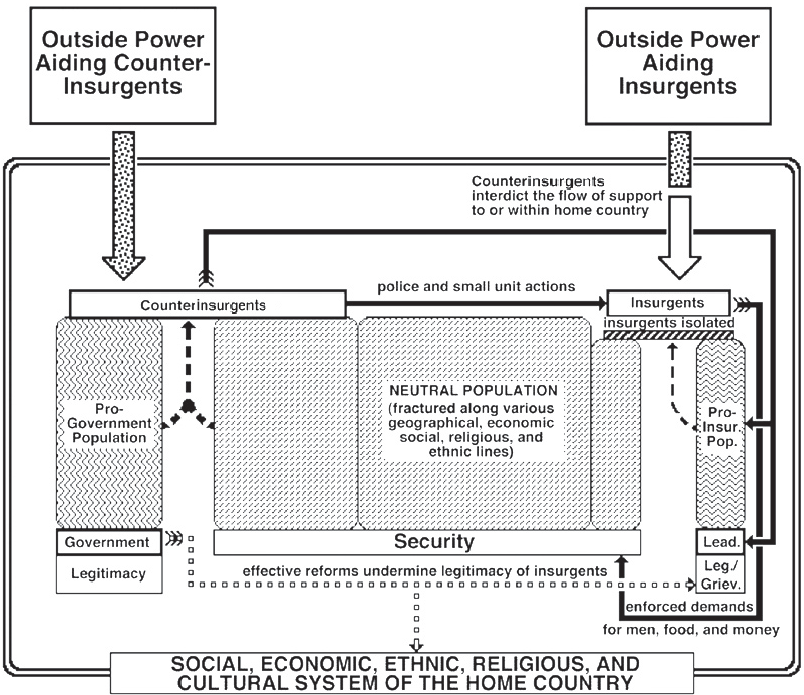
When studying police and military counterinsurgency tactics, you will find many such absurd charts that are nonetheless informative of how police and the State think.
A demonstration is meant to be a demonstration of power. An effective demo can be many things, but at its core, it’s a threat toward the State and capital: if demands are not met, then there will be consequences in the form of sabotage, strikes, or other direct action. However, a demonstration is still a demand, a request of the State to make concessions. If the State does, it will only do as little as possible to appease enough of the demonstrators into passivity such that the movement can no longer muster a threat.6 Through demonstrations, insurgent activity is funneled into channels that always lead to the parliamentary politics of liberal democracy. Mass demonstrations can easily become trapped in reinforcing the State even as they attempt to critique, modify, or replace it. Making demands legitimizes the ruling government and the State form more generally by positioning it as the medium through which change must occur. Demos serve as a pressure release valve that allows grievances to be aired and rage to be shown, but only in a way the State can contain. Without a demo, the rage would have to go somewhere else, and that is where the State is most threatened.
The State channels insurgent energy into demonstrations, and the counterinsurgency efforts continue before a demo has even started. Demonstrations “must” be registered with the police, and unregistered demonstrations are liable to be immediately quashed.7 Because of this, when we speak of demonstrations, we almost always mean registered (“angemeldete”) demos. When one suggests a Sponti (Spontandemonstration, “spontaneous [unregistered] demonstration”), the first thing out of anyone’s mouth is always “But the police will shut it down!” Before we’ve even started to take action, our planning begins on the police’s terms. We ask ourselves what we think they’d allow and then make that our main consideration instead of being creative and trying to stay one step ahead of them. The goal becomes “have a demo” with the expectation of positive results naturally following rather than us choosing what outcomes we want and then asking whether a demo is the most effective at reaching those. Once a demo is chosen as the form of political action, it becomes a necessity to (at least partially) obey the police. The choice of date and time, the negotiation of the route, the safety requirements, and the necessity and number of Ordner:innen are ultimately determined by the police.
When we organize demos, police are able to directly influence how we think and act via their liaison to the demo’s primary organizer. The organizer has to relay requests and demands, and the end effect is as if a cop is sitting in Plenum with us and is setting the agenda. The threat of a demo being shut down always hangs over us, so we are pressured into answering all sorts of tedious requests. We are asked to show what banners will be held, to provide copies of speeches, to show an agenda and be held responsible for deviations from it, and so on. Responding to this bureaucratic tedium takes time and it drains our energy from anything more insurgent. The experience is unpleasant enough that for many it makes them not want to organize another demo, or anything at all for that matter.
Still, most radical protesters see the police as a clear enemy. Even when someone doesn’t recognize individual cops as direct enemies, and even when they don’t recognize policing as structurally opposed to liberation, they can at least in the moment see that the currently deployed police are our opponents for the duration of the demo. Police announcements during demos are booed until they’re inaudible, and when we’re ordered to move from an area or disperse, there’s usually a minimum of passive resistance. Because of this, police alone cannot entirely contain protests and keep them pacified without resorting to a level of violence that risks turning public opinion or further radicalizing protesters.
Enter the Ordner:innen.
Those Who (Keep) Order
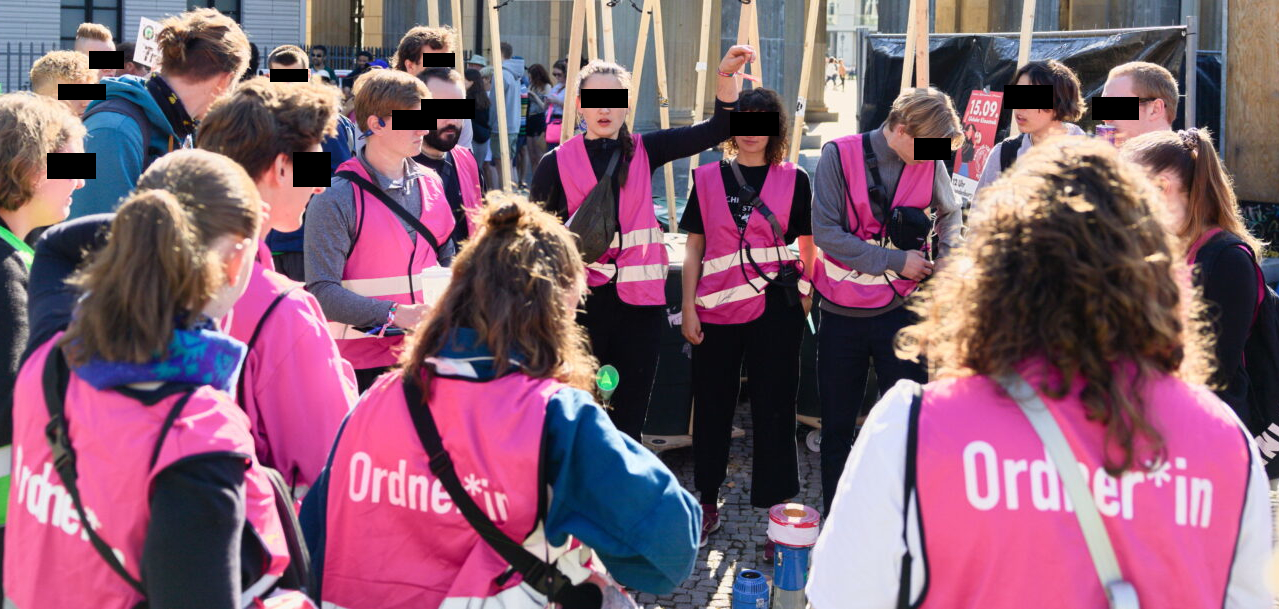
Ordner:innen translates literally as “those who (keep) order,” and they act to contain the demo within bounds set by themselves or the organizers. Sometimes at demos they’re called the Awareness Team,8 and in English-speaking regions they’re officially called demo marshals and pejoratively called peace police. The defined boundary of permissible acts is usually called (or included in) the Awareness Konzept.9 These bounds are often created through a consensus process between the Ordner:innen themselves and the organizers (but never with the participants). Ordner:innen show the authority appointed to them by organizers via matching labeled high-viz vests usually in pink or purple or sometimes via armbands. They often have radios they use to communicate with each other and the demo organizers.
Ordner:innen come in many flavors. In some cases they are actively sarcastic when relaying police commands. Some use their position to, in their parlance, run interference during police aggression often placing themselves in the way to be brutalized or arrested to protect others. These versions generally do not utilize their authority to control the demos. They are not the majority Ordner:innen and not who I am primarily concerned with here.
This is about the others.
Ordner:innen are extensions of the police into our own ranks. Their partial background as Awareness Teams from parties and festivals means they, at times, provide the desirable function of helping people in crisis (mental health, emotional, or substance related). However, they often act as an internal police force and direct their attention inward to enforce the organizers’ (or simply their own) goals for the demo over the safety and autonomy of individual participants. The demo reaching its destination is often prioritized over all others. Conflict with the police as well as provocative actions by participants threaten this. Often when police attack, Ordner:innen urge participants to act with restraint, and they physically block participants from coming into (further) confrontation with police. Before conflict even happens, Ordner:innen direct people on when and how to march such as containing people to one side of the road even when police have blocked traffic in both directions.
There was a time in recent memory where the police were afraid of demonstrations, at least a bit and at least sometimes. Even in the early days of the pandemic, there were moments when up close you could see fear in individual officers’ eyes. Squads hesitated before attacking, and they’d only approach the Black Bloc with excess numbers. This is rarely the case any more, and much of the current generation of protesters have only become active after this shift happened.10
“Quis custodiet ipsos custodes?”
— Juvenal
“Who orders the Ordner:innen themselves?”
— Scrapius Capybaricus
The overall chilling effect of internal pacification is that demos pose a massively reduced threat to the police on the street. When anger at a particular attack might boil over into action, Ordner:innen place themselves between the police and the demo. The internal demand to de-escalate causes pause that hinders action. Even if the demand itself wouldn’t be heeded, to get to the cops, one would first have to hit a “comrade” or someone “on our side.” This is quite taboo, even in the cases where the Ordner:innen are bunch of men who’ve been paid by demo organizers to act as internal police. At a moment when the demo might counter-attack or attempt to disrupt an ongoing arrest, it’s inhibited. The police know that they can attack and then retreat with a defense provided by the Ordner:innen. There is one less concern for them to deal with.
Ordner:innen steal from us times where we could experience our own autonomy. They steal flashes where we can act according to our free will or moral compass alone. They steal the feeling of solidarity with others as we stand shoulder to shoulder and feel these bursts of collective action, these brief instants where without exchanging words we know that others want to act and that they share our ideals and desire to immediately affect change. They steal the radicalizing moments of being directly confronted with police brutality that lay bare all the State is and that acting with others is the only possible response.
Ordner:innen don’t just enable police violence; they accentuate it. Through their interventions, our ability to exercise our agency atrophies. Long problems we have worked to overcome through workshops and drills beforehand or by hype during demos is generalized hesitancy and the fear of acting alone. We strike first less often, we antagonize with less intensity, and we stand less in unison when attacked so that every police charge spreads a little more fear and every hit lands a little more effectively. This pairs with the repression we feel internally from knowing that BFEs are filming and that any response at all has the potential to be caught on camera and used to prosecute us. By teaching us to not defend ourselves, we teach the police to be more bold and less afraid.
The roles that facilitate and support demos, including Ordner:innen, attract people because they want to help, and taking on a role feels more useful toward the demo than just being another body walking or waiting around for something to happen. Some join the Ordner:innen with good intentions and even consciously not wanting to engage in counterinsurgency or “cop shit,” but the role and its authority lend itself to such actions. The answer to this impulse to be useful is to form affinity groups and make plans to make the demo more active or to take on a different role that isn’t centered around controlling others. Trying to be helpful and protect others, when not done in a way that protects everyone and enables autonomy, can have terrible negative outcomes.
While not quite a demo, protest camps are common for a number of issues (climate change and Palestine in particular), and their organizers and participants are not distinct from the rest of the (demo) movements. At the Bundestag protest camp, there were cases were police stood around with tablets scrolling through faces previously captured by BFEs so they could arrest camp participants. In the name of protecting the more precarious and at-risk participants in the camp, and because the camps weren’t primed to respond to police activity, Ordner:innen diffused conflict during arrests and effectively served up people one at a time to the police. The events and camp operations running smoothly were prioritized over drawing attention to the incipient or in-progress arrests.11 The logic of this was that any single arrest could turn into several if there was resistance, but by preventing resistance, they made more total arrests possible. This framing assumes that arrests are inevitable, that we can’t stall police so others can help someone escape, and that performing de-arrests is impossible.
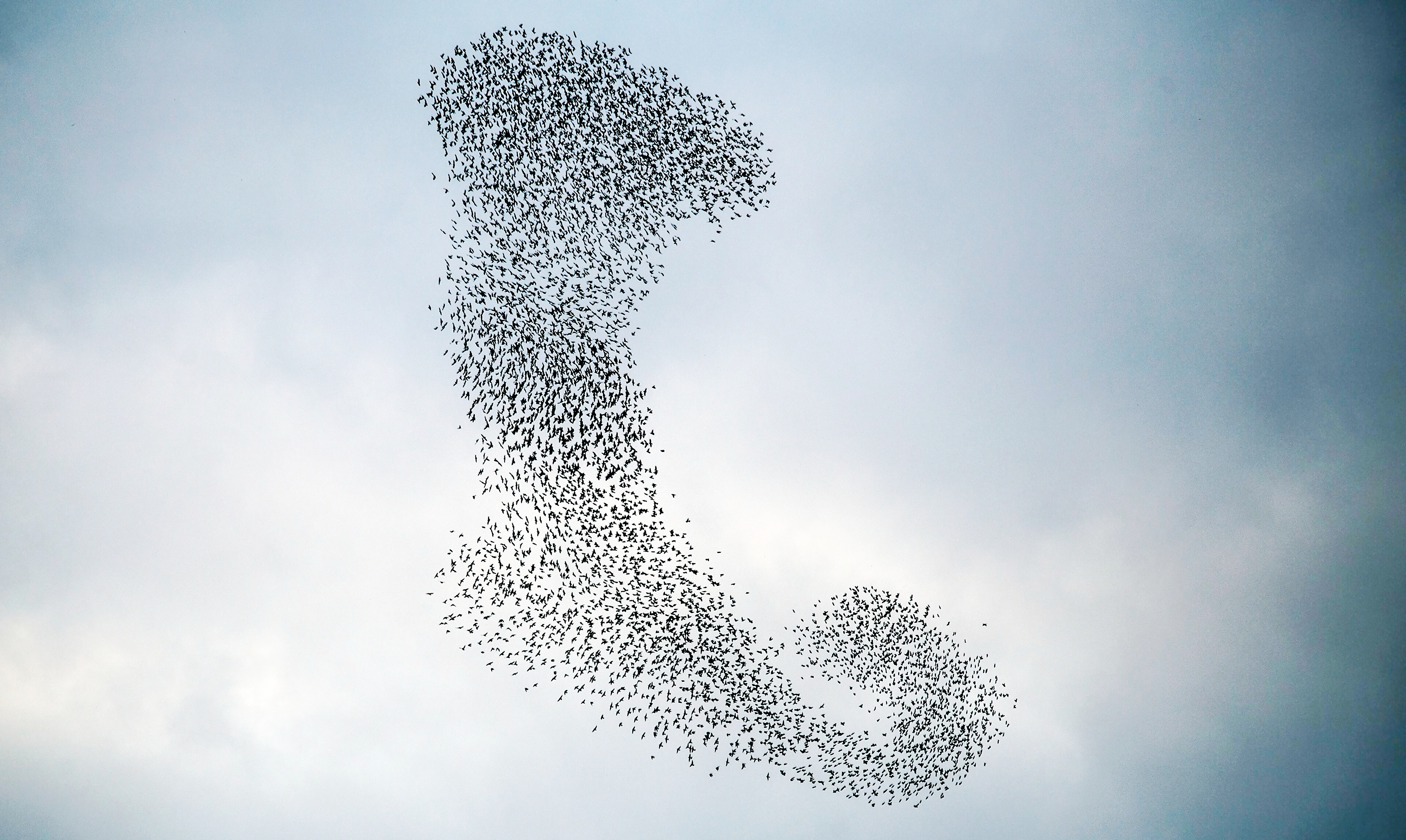
A murmuration has no leader and needs none.
What could we learn from birds?
A general trend over the past years not just in Berlin and the BRD but also through the so-called west is a decline in the Do It Yourself ethos. People look to have services provided for them, and they defer responsibility to those who specialize in a task. Even where we’d expect DIY to be the strongest, at anarchist (non-demo) events there are frequent complaints that there was no Awareness Team to moderate talks or kick out problematic individuals. When we see zionist or nazi graffiti, it’s often said “Someone should do something about that.” Yes, someone should: the person who noticed it.
The presence of Ordner:innen leads to other participants thinking they’re not authorized to act or that there’s an organized group who will do it for them. At our demos, we often don’t even attempt to kick out known snitches. We are urged to not block nazi and zionist streamers and to just ignore them, if we even make a move in the first place. It’s not just that the Ordner:innen don’t know or take the threat seriously; sometimes they agree that the person is a problem yet do nothing. It used to be that when someone would get injured, the crowd would shout together for medics, but that happens less and Ordner:innen set out to fetch them. Police easily send squads into the crowd during quiet moments, even before anything’s kicked off, and we make virtually no effort to hinder their presence and barely even acknowledge it. During police attacks or arrests, too many people stand back (or worse, stand in the way) and film with their phones in hopes that footage vindicates what we’ve been saying or that justice will be carried out against the police (by who, the State?). We have collectively learned a passivity and to accept threats over confrontation in hopes that someone else might deal with whatever problems arise.
Ordner:innen always suppress autonomy either actively or by showing that one must wait for an authority figure to give permission to act, and the long term effect of this is greater susceptibility to repression.
An event takes on the qualities of the participants, and it’s made (or not) by their (in)actions as well. Events are seen by too many as something provided for consumption and less as something actively built. Ordner:innen contribute to this by taking away some of the elements of active participation in a demo. Some of these complaints about Ordner:innen are voiced by others, but I don’t think we fully understand exactly how damaging this theft of autonomy really is to us as individuals or the movement or that it’s even happening.
There was a period after 7.10 where there seemed to be recognition that formulaic registered demos were not effective at stopping or even slowing Israel’s genocide in Gaza, and there were stealthily planned acts of civil disobedience. One of the larger actions had a few hundred people, yet even without the rows of riot cops or the Ordner:innen bossing us around, people didn’t know what to do. The crowd was reluctant to flock together or move in ways that would have eluded or at least delayed police capture. We were kettled because some of us forgot how to act on our own and because some of us only attended pacified demos where we never had the opportunity to learn. Afterwards, I saw a friend of a friend, someone who called herself an anarchist with whom I’d briefly exchanged words a few times. We talked for nearly half an hour about the loss of agency, the hesitancy, the confusion at what to do when there was no one ordering us around. We talked about what we could do to help people learn to think for themselves and how to act without asking for permission. It sounded like we had a shared understanding of the phenomena and could work together to alter our collective course.
Only two days later at another Palestine demo, after police attacked and arrested people, I saw her wearing a high-viz vest and linking arms with other Ordner:innen to form wall to push protesters back.
Seriously, what the everloving fuck.
There are plenty of autonomous demonstrations that have the required Ordner:innen but who fulfill the role in uniform and title only and otherwise do not interfere with individual’s actions, but I want to stay on the subject of Palestinian solidarity to draw a more direct connection and give another example about how incredibly quickly and pervasively this internal pacification can happen.
On the nights of October 17th and 18th, not two weeks after the attacks against Israel and in response to the IOF bombing the al-Ahli Hospital in Gaza, spontaneous demonstrations of almost exclusively Palestinian and Muslim diasporas turned to small riots in Neukölln. The demonstrators had no leader, and they acted on their will alone. They attacked the cops with a sense of joy, laughing and cheering after getting away. That very weekend, the professional managerial class of Berlin radicalism organized an incredibly dull and formulaic demo where Ordner:innen physically intervened to prevent demonstrators from confronting the police.12 Those two nights in Neukölln were the most free I’ve felt at any Palestine demo, and two exceptions aside (one registered demo and one Sponti), there have been no Palestine demos since were I really felt like we were either a threat or momentarily free. This is mostly attributable to the suppression of action by Ordner:innen, either by direct intervention or from the latent chilling effect of their continuous pacification.
Recuperation is the process by which radical and subcultural ideas are diffused of revolutionary potential and pulled into the status quo.
This example of recuperation is indicative of how insurgent energy in general is absorbed into toothless progressivism. Right after 7.10, autonomous subaltern and proletarian resistance was captured by institutional collectives largely made up of relatively privileged individuals that could churn out demos. People wanted to take to the streets, and they wanted to do so en masse,13 so they gravitated to the larger frequently organized demos where they were pacified by those who sought to control and lead the resistance. Even when collectives had radical elements or engaged in more direct action, they overly focused on demos due to pressures of guilt or weaponized identity politics from moderate elements within them. Feminist, anti-racist, and anti-classist languages of safety and inclusion were repeatedly deployed to preempt conflict, and nonviolence was championed. Ironically, this paternalism in the name of protecting Palestinians happened despite them being right from the start the most ready to fight and risk their safety. There were continued registered demos and mini riots in Neukölln, but they were mostly happening adjacent to the “main” movement. These people wracked up arrests and charges, and so far as I and friends know, they were largely left to fend for themselves and deal with the repercussions without support from the rest of the movement.
The “institutional” collectives we have here are much harder to identify as sources of recuperative progressivism compared to large classically institutional NGOs, yet they serve the exact same function. In a way, they are more insidious because they’re harder to identify as recuperative because they use more radical language, have no funding, and aren’t registered as non-profits. Something similar to the post 7.10 Palestinian solidarity actions was the George Floyd Uprising in the US that started in May 2020. Despite its much larger scale and higher intensity, radicals from that region wrote about how NGOs and figureheads immediately captured, pacified, and deradicalized the movement. Within weeks of George Floyd’s murder and the subsequent burning down of the 3rd Precinct (a police station), this capture had happened even if the riots waged on for months after, and it was a significant factor in why the uprising never morphed into full insurrection.14 Police there described NGOs as “force multipliers” of their counterinsurgency efforts.
The Palestinian and Muslim diasporas involved in the solidarity movement pull from a wider range of age and class than the typical Berlin radical scene which is overrepresented by those in their 20s to 30s, who are middle class, and who attended or are attending university. Palestine events have more families, children, and the elderly than others. Those perceived to be immigrants are more targeted by the police for repression and brutality. Because of additional precarity or the possibility of deportation, they risk more by attending demos. In the name of countering this repression and fostering inclusivity, demo organizers and the Ordner:innen will at times make protecting the demo from police repression a priority over all others. Which again, this is an expression of paternalism since the most active and feisty parts of the demo are usually Palestinians and Muslims.
There is frequently tension between demo organizers and participants around expectations and behavior at demonstrations, and this is particularly acute at Palestine demos. Many who attend demos are there to enter conflict with the State and see the police as a visible manifestation of State control. Wanting to antagonize the police gets described as machismo and patriarchal because taking action is seen as an attack against the demo and its primary goal of reaching its destination. It’s “individualistic.” It “breaks unity.” Suppressing action is seen as defending the demo.
A goal of the State’s counterinsurgency is to separate out the most insurgent elements from the general population to prevent their ideology from spreading and them from recruiting. Whether Ordner:innen are cognizant of it or not, the State acts through Ordner:innen who via pacification drive away the most radical elements who might attend demos. We make note that in mass society, complacent moderates allow those who have claimed power to continue to rule over us, and one of our struggles against domination is convincing others to let go of the so-called consent of the governed and to take charge of their own lives. Yet, even within our own circles, we cannot get those who attend demos to recognize and break the hegemonic social norms we’ve established that allow Ordner:innen to dictate our behavior, and often we do so for the same reason: we too want safety. The State makes territorial claims and then pushes for a monoculture aligned with its vision of identity, and this is enforced by violence and exclusion. Those who organize radical spaces and events including demos tend to do so in a vanguardist way where they assert dominion over the space and enforce norms and customs through a similar exclusion (yes, at times anarchists do this too!). The border of the demo and what is acceptable is defined by the organizers and primarily enforced by Ordner:innen. Our struggle as those within mass society pushing for egalitarianism against the State and police is directly mirrored by the fight we as radicals pushing for action within vague leftism have against the professional managerial class of the left and Ordner:innen. Being unable to create change in this microcosm bodes poorly for creating change in the world.15
Order and decorum über alles.
Pacified demos themselves discourage and Ordner:innen actively drive away some of the same autonomous and antifascist elements of the movement that are sympathetic to the cause and are criticized for not participating in Palestinian solidarity.16 By driving certain people away from organizing and the demo itself, the pacifying elements bring about their desired reality such that with time there is evermore validity to the claim that pacification is the (majority) will of the demo participants.
Consider the following all too common scenario, something you’ve probably experienced yourself. As police actively attack a demo and beat us, an organizer (usually a femme person, simply because more femmes are organizing) takes the mic, and over the sound system orders us around in either German or English saying “Lasst die Polizei euch nicht provozieren!” or “Don’t let the police provoke you!” Telling people being beaten to not resist is to side with the oppressor, but it goes further. There is a general belief that the police target people who they can more easily carry out violence against such as physically smaller people and femmes, and we know that (brute physical violence aside) as part of arrest and detainment, protesters are groped and otherwise sexually assaulted. To have someone use their position as organizer or Ordner:in to effectively tell protesters to lay back and take it is fucking disgusting and an absolute betrayal of feminist principles. So long as they continue to behave this way, these people are enemies of liberation.
Action Level: Extremely Mid
A recurring line of reasoning for why we as radicals should continue to host demos in their current format is to involve people whose action level is limited to attending demos, and in particular there’s an assumption that the most vulnerable people have the “lowest” action level. Anyone who has been to a Palestine demo can clearly see that this isn’t true.
We imagine a spectrum from being the most docile and hoping fascism can be voted away to being the most militant and founding an urban guerilla network. On such a spectrum, attending a demo falls “below” direct action. But that’s all this spectrum is: imagined. In our minds, either criminalization or militancy is the primary axis by which actions are measured. Such a spectrum leaves little room for either analysis of effectiveness or for creativity in action.
Two things are reinforced by using this particular action-level phrasing. First, that more direct or effective action would lead to experiencing more repression than attending the already violently repressed demos. This claim can be rejected by the number of arson attacks including the massively investigated January attack on the Lichterfelde power substation that have not led to arrests. Second, that these demos themselves are somehow sufficiently safe for vulnerable people to be attending. We also know this cannot possibly be true given how many of our marginalized comrades are repeatedly brutalized and arrested, how many of them have to attend court for charges they caught while at demos. We are telling people to clamber into the jaws of the State and position this as safer than other methods.
What might be more effective while also being less risky will likely involve smaller groups acting in a DIY manner and doing secretive or clandestine actions. Or, maybe something else entirely. Maybe intense mocking harassment of people doing shitty things but whose minds we believe can be changed. Maybe persistent outreach to neighbors to get them on board with BDS. There are so many possibilities.
We need to remember that our solidarity needs to match intensity of those we’re in solidarity with. When comrades elsewhere in the world riot or rise up against oppression, we need to ask ourselves how we can carry that energy to our local context. A well-ordered registered demonstration generally does not match that energy. We need to remember that they’re trying to change the world, and we need to keep that centered in what we do. Their fight is exactly our fight, and our liberations are inextricably wrapped up in each other. The fight is global, not just some thing we do in Berlin on Saturdays.
In the Spotlight
We are being surveilled from without and within. BFEs surveil us. Nazi and zionist streamers do the same. Journalists capture our images and post them online, sometimes to malign us and sometimes not caring if doing so could be used to prosecute us. Allied streamers profit socially and financially from plastering our image all over the internet where cops and fash slurp up the documentation of our activities. Well-meaning protesters snap photos and videos to post either live or afterwards. They make short streams of their own during joyous or intense moments. None of this is done with privacy or pixellation in mind. With few exceptions, every single person filming contributes to our collective repression.

When on the front line, even when we can see there’s no BFEs filming us, every past camera we’ve ever seen at a demo sits in our minds, and we can feel their watchful eyes. When we might land a hit that makes our assailants hesitate before striking again, we can feel them watching us. What if this punch, this shove is the one that gets caught on camera, posted online, and lands us in prison? When we’re further back, we don’t throw stones or bottles because someone might be filming us. Cheap phones still have cameras powerful enough to get a conviction, and they’re everywhere. Like in the panopticon, we are compelled to self-regulation.
People believe that filming the cops will prove they’re lying and exonerate arrested comrades, and while there are some cases of the latter, it infrequently happens. Conversely, protesters have been convicted because of images and videos posted online. We hope to catch cops in moments of excess force in addition to their lies, and we hope that this footage will lead to consequences of some sort. We want to believe public or international pressure might force the hands of politicians to rein in their enforcers. In particular, a case that’s been brought up in favor of filming the police is that of officer 24111 where the police were caught in an obvious lie. However, the careful investigation has borne no fruit,17 and this is of no fault of the journalists who broke the story. This is simply how the system works, and any hope we place in legal proceedings working against them only serves to reinforce authority of the State. Empirically, the constant filming is not helping. The court observer and support group Solidarische Prozessbegleitung (Solidary Court Support) issued a report in September of 2025 titled Court Watch: April 2024 – August 2025 that said:
[We are] not aware of any convictions or any repercussions for Berlin police in the monitoring timeframe for their unlawful use of force at protests, despite extensive evidence of the police using unnecessary or excessive force against peaceful protesters, often causing serious injuries.
It’s a bit damning of the movement that people still see the courts as more likely to effect change than the actions we take ourselves. We film because we believe its the only reasonable path to change. But we must remember that the only meaningful consequences are those we create ourselves.
Since a goal of filming to is expose police brutality, a trend at some demos is to film people who have been beaten by the police. As people bleed from the head and worry about concussions, hospital visits, and the looming threat of arrest, people stick their phones in the faces of the injured and the medics who treat them in hopes of capturing these vulnerable moments. This is similar to the slight dehumanization that happens when filming police violence more generally. The individuals being attacked become abstracted as “the crowd” or “a protester,” and their suffering is something to be nonconsensually instrumentalized for the broader struggle.
This is particularly upsetting because people risk arrest and prosecution for blocking police cameras, and we are in some strange post-pandemic post-7.10 era where facial coverings like medical masks and kuffiyehs are effectively permitted following years of harsh criminalization of obfuscation and concealment (“Vermummung”).18 And while protesters take these actions to block surveillance, they’re filmed by other protesters from behind, both endangering them and those they’re trying to protect.
There used to be more of a culture of prohibition against cameras, but this has been significantly eroded throughout much of the protest movements. It continues to be a problem because we don’t intervene either with persuasive arguments or direct action. Our lack of interventions is exacerbated by the presence of Ordner:innen who by doing nothing use their authority to implicitly grant permission to those filming and photographing. Though in reality, the kinds of demos with the most Ordner:innen are the ones most likely to be at least partly aiming for a (social) media spectacle, and every like counts!
Filming doesn’t just cause us to hesitate. Those doing it actively inhibit action. When police surge or during an arrest, many whip out their phones to catch the violence either in hopes of creating evidence against the police or for getting a thrilling shot for Instagram. Any move that counters the police is hindered by everyone who pushes to the front to get better footage. We gamble inaction in the present against some imagined future salvation from our oppression, but this rarely if ever comes. But then again, a huge portion of those filming aren’t even hoping for positive outcomes for the movement. They’re only trying to create “content” they can capitalize on. Those who film are not active participants in the demo. Whether they realize it or not, they are merely spectators.
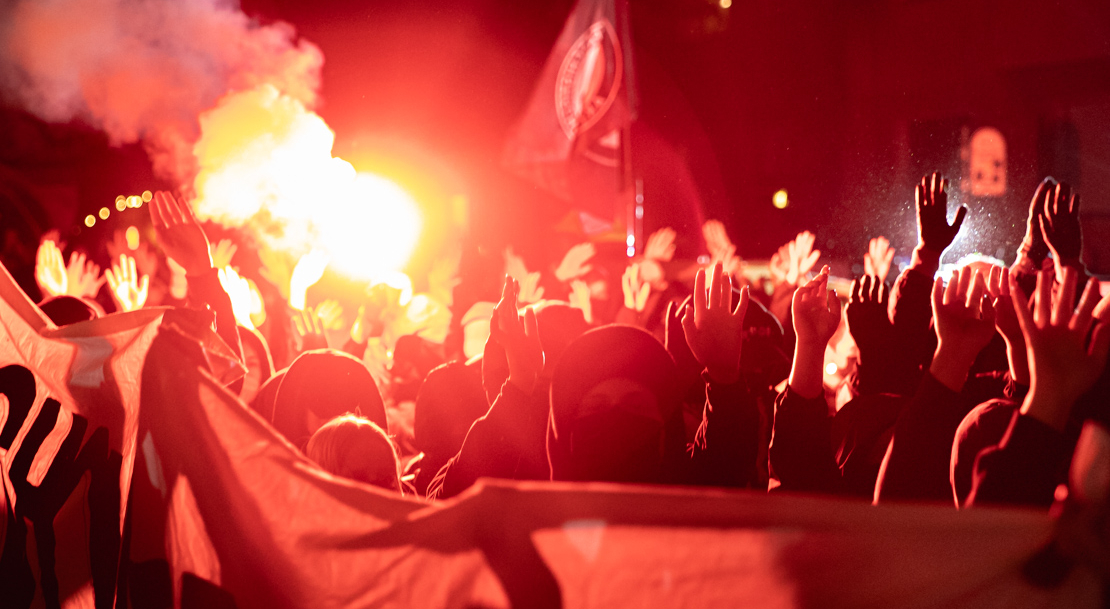
These issues are often repeated,19 but what’s less discussed is how constantly being filmed causes us to prioritize performing radicalism over actually doing it. We shout at cops and levy sick dunks so that others can smash that like button in response. We stand proud and tall, flag or banner in hand, in hopes of striking such a pose as to end up on /r/AccidentalRenaissance. We don’t defy the cops in the sense of figuring out what they most want and acting against it, but we focus on creating the appearance of defiance with a raised fist or middle finger, yet we do nothing to undermine their control. There doesn’t even have to be a camera noticeably pointed as us anymore. We just assume they’re there and act as such.
The only people who should be photographing or filming at demos are trusted and competent journalists (of which there are few) and dedicated cop-watch groups (of which there are none I know of in this city). Everyone else is a passive spectator, a hurdle to action, or an active threat.
The Demo-Plenum-Industrial Complex
There is an incredible amount of infrastructure built around demos from planning to executing to supporting the long-tail of consequences of them. There are collectives that (solely) plan demos. Collectives of Awareness Teams. Of medics, translators/interpreters, legal observers, social media posters, jail support, legal/court support, and so on. Once a collective focuses on demo support, it’s hard for it to overcome inertia and shift away. Once one becomes involved in a collective, they are likely to stay with it. Demos funnel people into collectives that are most involved with demos. Thus, something I mockingly call the Demo-Plenum-Industrial Complex is brought into existence and self-perpetuates.
“Wait. You call it an industrial complex, but we’re all anticapitalist, so what’s it generating?”
Social capital.
More than we’d like to admit, much of what we do as radicals is the curation of public image and the accumulation of social capital. What gains social capital varies within the different milieus of the radical left scene, but there are two that are particularly widespread: being involved in the hubbub of organizing and being able to demonstrate enlightened and reflective intersectionality.20 Of the first, there’s social capital in having to selflessly rush away to Plenum, and some brag of having to attend different Plena every night of the week. Plena are treated as the place from which change springs, and being involved in rigid collectives with many such meetings shows both dedication and direct involvement with that change. Of the second, one of the core traits of this strange coalition of underdogs we call “the left” is alignment with the most marginalized and effort put toward creating a more egalitarian world. We generally lack the power to change material reality, so we instead focus on demonstrating our values on the micro like nitpicking someone’s choice of language (an ever-shifting target) or loudly and boldly proclaiming solidarity with other causes (that we can often only can trivially support). We rigidly adhere to bureaucratic procedures for our meetings believing this is a counter to the current mass society we’re trapped in.21 Intersectionality and internationalism is most easily shown by mentioning other causes we support or defer to, but that is frequently where the support ends.

Is this genuine détournement, or are we just aligning ourselves with a Branded Antifa Experiencetm?
Demos are stages where organizers can present a public image, and the attendees likewise benefit not so much from being informed about a topic or politically educated into dangerous revolutionaries but more from being able to associate themselves with the image of what the demo represents. This isn’t saying that we don’t genuinely believe in the things we say or listen to, nor that we don’t want international solidarity with all oppressed people. It’s saying that we don’t recognize that the production and marketing of demos and what we gain from them is not as far off from the production and marketing of branded goods or services and what consumers gain from them. The consumption of the demo is the participation.
The Demo-Plenum-Industrial Complex pulls us in and sucks up our time, and it produces valuable social capital. Imagine how much effort could go into direct action, mutual aid, and labor or tenant unionizing that actually change our material conditions, are less repressed, and are more likely to develop strong social bonds. Many such projects lack support or even recognition because much of this work doesn’t produce social capital. The work isn’t flashy or exciting. It can’t be easily shared on Instagram.
Similarly, demos become sites where individuals can produce their own social capital. Arrest carries social capital because in some cases we correlate being actively repressed with being effective and in others we view it as self-sacrificing and heroic. Streamers on the sidelines can film what’s happening, and when action kicks off, participants will film to post later to be part of the distributed media frenzy around the demo. Online discourse and drama become sites where one can maneuver themself against other positions to elevate their own or simply fight with others to draw attention to themself. There’s been an online-ification of demos in the past years, and while this hasn’t really hit the autonomous parts of the left, it’s something that threatens to spill over.
Demonstrations in Berlin have, for the most part, become social events. I know plenty of people who show up to demos prepared for conflict with the police and use themselves to shield the less prepared and less feisty parts of the demo, but they are in the minority. All the same, there is a subculture of demo-attendance where the question “Been to any demos lately?” is our equivalent of normies asking “Catch the game last night?” There is sociality in joining collectives to plan them and meeting friends to attend them. At demos, one gets to see a great deal of their friends and acquaintances, far more than one might run into on a random night at their local bar or café. Demos have grown as ephemeral third spaces where we spend our free time while their DIY ethos has declined. Despite (or again, is it because of?) the constant surveillance and threat of police violence, there is progressively less focus on active participation. Speeches are half-heartedly listened to, and catching up with contacts becomes a priority. Blocs are loose, and even with loud encouragement, people are sluggish to close gaps that allow for police incursion. The watering-down of demos as concerted political acts is made visible in one disconcerting way by the bizarrely large number of people who have dating profiles with pictures of them striking tough or cute poses at political demos (ones that are not merely parades) in front of riot cops or police vehicles as well as the suggestion for attending demos as a possible date activity.
The social nature flies in the face of the solidarity we’re supposed to be showing. In the Palestine context, it feels especially discordant compared to the many who are out at the demos from a place of grief and desperation as they try to fight for loved ones in Palestine, Lebanon, Jordan, etc.
Socializing at demos isn’t bad per se. Demos always will and should be used to build and strengthen social bonds. If building such bonds is the goal, we might be better served if we stop describing them as a fight to reclaim the street and just have block parties where hundreds to thousands of riot cops won’t be invited to brutalize us. Just as much, this is partially on those of us who want to keep demos political for not mobilizing other activities, not normalizing desired behavior, and not shunning undesired behavior.
I’m also not saying that infrastructure for demos is harmful or bad. So long as we have demos, GeSa support, legal support, medics, and such will always be necessary. I’m more trying to draw attention to the massive time and organizational effort that goes into to them relative to what comes out. This all comes back to the same question: what are we actually doing with demos?
It’s often said that the purpose of a system is what it does. What do our demos do? They’re not freeing us, and they often bore us. They are primarily social, and it would be one thing if this kind of socializing drove us to greater action, but it doesn’t. It’s just demo after demo, live stream after live stream. We need to break the cycle, to smash the Demo-Plenum-Industrial Complex.
A Confusion of the Real and the Unreal
Berlin has a bohemian and riotous history, and we in the present bind ourselves to these legends. There is a continuity of our movement going back to the anti-globalization days, back into the squatting movement that straddles the years before and after the fall of the wall, back into the anti-nuclear movement, the urban guerillas, the ’68ers, the wartime nazi resistance, and so on. We look at the militant antifascists before us and at multi-day street battles. We see ourselves in them. We aspire to be them. And in this pursuit, we first adopt their symbols as we try to recreate the past.
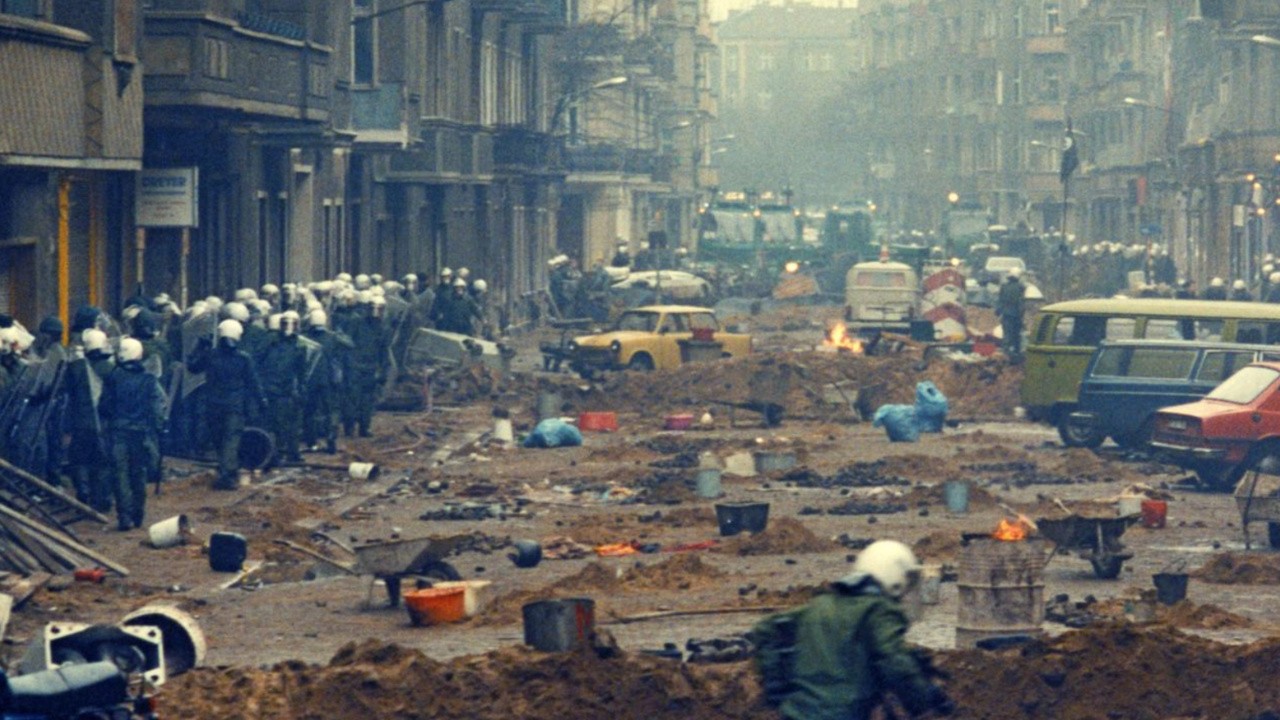
The Battle of Mainzer Straße from November 12th to 14th of 1990 is the stuff of legends.
We consume a slurry of images and videos of demos, of our own subcultural signifiers, of manifestos and reportbacks, and in doing so, we have fallen victim to our own propaganda. This deceit disarms us. Pick any random demo that’s presented as radical or militant and we can see this process.
These demos often are named with titles using words like revolutionary, fight, struggle, smash, revenge, and so on. They have a mobilization call on their website or social media and maybe a manifesto too that uses bold words and makes grandiose claims. We paint banners and wrap them around the demo itself, set off pyro and bengalos. We chant aggressive slogans, and people post about how solid (“stabil”) and militant (“kämpferisch”) the demo is or was. Afterward, videos and images of raised fists, pyrotechnics, and fights with the police bounce around internet and gain a flurry of chatter in their wake. We make reportbacks of our successes. Sometimes instead, we post videos of how much we were attacked by the police as if to prove the existence of their unjust brutality, and we use maximal language to describe what they’ve done. We post, we rant, and then we move on to plan the next demo.
We treat signs of radicalism as radicalism itself as well as signs of militancy as militancy itself. These signs have become so divorced from their actual originals via iterations of copying and distortion that we no longer are able to tell when we’re looking at or reacting to a hollow copy or the actual thing. The gap between what is claimed and what exists is so incredibly large.
“It is no longer a question of imitation, nor duplication, nor
even parody. It is a question of substituting the signs of the real for
the real.”
— Jean Baudrillard, Simulacra and Simulation
Let’s look at our slogans to start. Demos are typically flanked by the police with escorts ahead and behind. We chant “Whose streets? Our streets!” or “Wir! Sind! Unregierbar!” (“We! Are! Ungovernable!”), yet we’re only on the streets because the police are allowing us to be. They decide when and where we march, not just in the planning phase but also while on the streets, arbitrarily stopping demos and rerouting them. We say that “Pride was a riot” and then show up in costumes to a parade we invited the police to, forgetting that the Stonewall riots were a community of people out drinking on a Friday who spontaneously started fighting the cops in response to a raid. We shout “Intifada revolution!” and “Death death to the IDF!” and “Five, six, seven, eight! It is time to escalate!” as we follow the commands of Ordner:innen to stay orderly otherwise we’d upset the police. What does escalation even mean? Very few people are doing direct action, and a large amount of the demo is passive (generally) or unwilling to contest the grip the Ordner:innen have on the demo, much less that of the police.
Slogans are often aspirational, and this is okay. Saying “Palestine will be free!” is saying that our goal is to change the world to make that true. Saying “Whose streets? Our streets!” is a statement about the current moment that, in most every case, is by no reasonable measure true. The words no longer have meaning, and we deceive ourselves into believing the restricted freedoms or low ceiling of action we take are what freedom and action actually are.
A significant part of demos is the production of images meant to elicit responses. What we say and show of demos, how we self-censor and edit images often include hype, agitprop, redactions in the name of security, and intentional self-delusion. Even if we know these filters exist and try to look through them, our perception of reality exists in a confused state where we cannot separate out the real from the unreal, and often we are unaware of this confusion. At its core, it looks something like this:
Most radicals can point out that Facebook and Instagram poison people’s brains with algorithmically served posts that warp their perception of the world.
Most radicals can point out that influencers and social media more generally create unrealistic and unattainble beauty and lifestyle standards that lead to poor mental health and people following harmful or profiteering trends.
Most radicals can point out that advertising is propaganda that manufactures desire based off a false presentation of humans, their sociality, and the choices available to us.
Most radicals cannot point out that the (grassroots and bottom-up) media frenzy and gossip around demos does all of the above to us too.
Depending on who one follows, one might encounter overflowing positivity toward demos and believe that these constrained and minimal actions we take are what success looks like. Or, one might follow doomer accounts that only post brutality, and see demos as far more violent and police as far more superior force than they actually are. The police might not really understand what happened at a demo, blinded by their own ideology, and the public seeing what happened through a (mostly) misleading press doesn’t either. So if we (even as participants) don’t understand the demos, then does anyone?
The Political
Demonstration
Did Not Take Place
Even deeply embedded in this, it’s totally disorienting attempting to get a bearing on what people actually believe. Is what we’re saying doublethink, self-delusion, propaganda, hype, or motivation? Do people genuinely believe these demos are empowering? That obediently marching from A to B while surrounded by police is militant? Surely some who have never attended a rowdy demo or even a demo at all might genuinely find it so given that it’s a change from normalcy, but what about the rest of us?
Regardless, we need to be be able to differentiate between an effective demo and an ineffective demo at a level that goes beyond aesthetics and symbols. The language and appraisals of such demos needs to be distinct. A much as is feasible, we need to be able to describe reality for what it is and have a shared basis of what is objectively happening if we hope to change anything at all.
Making the Streets Ours
What would it mean for the streets to be ours for a week, a night, even a moment? This zine so far has pointed the finger at many problems and parts of them that are under-examined, but it’s offered few solutions. What follows is not meant to be a prescription for how a demo must be, and maybe not even how it should be. Consider it sketching out what might make for good or effective versions of different kinds of demos. Use what you can, debate the rest, and throw out the leftover garbage.
While I have often argued against pacification and the suppression of autonomy from Ordner:innen, I’m also not generally arguing that every demo should be hyper-militant and aim to become a chaotic riot. Parades to show numbers for a cause still have their place. Consider the demo “All Eyes on Gaza — Stoppt den Genozid!” from last September in Berlin. Organized by several groups including the german branch of Amnesty International, it drew over 100,000 participants and was undersigned by a huge number of organizations and individuals including many of fame and social prominence. This demo served as a sign that german society might be breaking from zionism and the german Staatsräson, and to that end it was effective even if quite tame and non-threatening.
There are times when yearly demos can be effective ways to show that we have solidary with each other. They can be useful expressions of collective grief or mourning. They can show us that history is not so far in the past and that old struggles are directly tied to modern ones. The 8th of March, the 25th of November, Nakba Day, Kristallnacht, ACAB Day on 13.12, Oury Jalloh’s death in January, Hanau, Halle, and so on. However, there are so many such days if we go beyond the most popular. Letting go of some of these isn’t “abandoning” a cause, nor is it “forgetting” those harmed or killed, but just as well, we can’t demonstrate in perpetuity for every wound we’ve suffered. The radical movements must be more than just memorialization and public-awareness services.
Mass counter-demonstrations against fascist marches or gatherings like an AfD Bundesparteitag are quite important. They show a direct grassroots response from civil society against rising fascism, and they are a way to radicalize moderates and find common ground between different parts of the struggle. When done well, they effectively disrupt fascist activities through direct actions like blockades and attacks. They are pure expressions of antifascism, blending both militant and mass tactics, but these can easily slip into bland symbolic expressions of distaste.22
Again, militancy and riots alone are not panaceas. Look at our neighbors to the west who riot across France like during the Yellow Vest movement to the current student uprising and so many more in between. Those living there go hard in ways we do not, but they are still being crushed under authoritarian neo-liberalism. Of course, the intensity of sustained protests there has certainly slowed the encroaching of such policies. What we can see in such protests, or like the sustained pro-abortion ones from our neighbors to the east, or the pro-democracy ones in the Balkans or Caucuses, is that regularity and a lack of a central authority is a factor in sustaining the protests. What if three years ago there were calls by all the groups in solidarity with Palestinians to go to Neukölln every night? What if instead of organizing Lautis and speeches and formal demo routes we instead simply suggested that people use a space and time to experiment with autonomy and self-organization? The regularity is preferable to frequent but randomly scheduled and competing demos. The irregularity makes attending a demo a mere choice.23 It means that one’s existing lil’ projects can be prioritized over actually showing up for flash-point moments that really fucking matter.
At times mocked and derided by radicals, the mass climate movement of the likes of Fridays for Future and Extinction Rebellion still managed to drive the discussion about climate change and the ills of infinite growth into mainstream discussion. Greta Thunberg is practically a household name (for better or worse). Greta herself like so, so many others in the current Palestine solidarity movement cut their teeth in the climate movement and became radicalized through it. I had extremely middle class coworkers join XR direct action groups, and by comparison the “classic” autonomous parts of the left have rather failed at enticing people to do so. Part of why these mass recurring demos had such an effect is that this is the sort of issue people care about and recognize directly affects them. And, they had obvious on-boarding into more than just attending another protest. What are the other issues in Berlin that could function similarly? Anti-militarization? Anti-gentrification and tenant organizing?
Prison noise demos, both periodic ones for political prisoners and recurring ones like on New Year’s Eve, are important because they are real solidarity, not merely symbolic solidarity. They directly connect the prisoners inside with those outside. The former are shown they are not forgotten, and the stakes of our struggle are made more real to the latter. This is one way the chant at so many demos is turned to action: “Wir sind nicht alle; es fehlen die Gefangenen!” (“We’re not everyone; the prisoners are missing!”). These demos have a clear purpose where the demo form is the only one the action can take.
Between waves of mass protest, we have to keep our skills honed, so if nothing else, periodic demos with varying levels of militancy still serve as proving ground for tactics. More militant demos when well executed serve as stark reminders that we have collective power and that police control is not absolute, and while there is no secret recipe in terms of mobilization and action that can create joyful riotous moments, the careful and experimental pursuit of such is not something we can give up on entirely. But like this text has (hopefully adequately) shown, simply showing up and hoping for militancy can train us to be timid and hesitant, can do nothing more than expose us to traumatic police brutality.
Those were the broad classes of demos that can be effective and also why, but there are also tactics and behaviors that we should aim for during any demo at all.
We need to learn to talk to each other during demos, and for us Berliners, this seems to be a tall order. A wholly paranoid security culture and general awkwardness stands in the way, but so many changes depend on the ability to communicate. The only way to normalize talking to others at demos is to overcome whatever fears or anxieties hinder us and just do it. Change won’t come any other way. Sorry. You will have to get uncomfortable.
Filming has to be made unacceptable again. The constant sousveillance24 is incapacitating us. Individuals and small groups absolutely need to counter this whether it means getting journalists to stay back when things start to pop or to get people to stop whipping out their phones the second something of minor interest happens. This could be a simple as a quick conversation once heated moments cool off, or it could mean tripping those running with cameras raised or smashing the phones of those filming.25
Police patrols through our demos before they start or during quieter moments need to be resisted. This could mean talking to others to get them to stand closer together, to tighten up blocs, to close gaps as we march. It could mean following plain-clothes (Zivi) cops playing NWA’s “Fuck the Police” on a portable speaker so that everyone knows where they are. But maybe it starts with even just talking to others to get them to remember that the police are our enemies and that the demo needs to defend itself from them at every moment.
In cases where Ordner:innen utilize authority to control demos, they need to be undermined. When they order us around, even something as simple shouting back that people don’t need to listen can have large effects. Like with filming, frank conversations about how their efforts are counterinsurgent could be enough to change behavior, and where that’s not, a simple “Fuck off, cop” whenever they order you around could be enough to pierce through their self-perception as friends and helpers.
Our choice of actions and therefore our ability to reshape the world is dependent on our understanding of the current world. We need to be able to meaningfully assess whether a demo was good or bad, effective or ineffective. We need to be able to identify when demos are extractive and leave us drained versus when they’re nourishing, when they help us build capacity and feel hope and agency. We can’t dismiss all critiques as pedantry, doomerism, or Haterade.
We need to improve our collective memories. When things don’t work one year, they probably won’t the next, nor in three or five. Collectives come and go, and our ability to transmit what we’ve learned is very poor, sometimes because of people aging out of the movement, sometimes because of ageism (in both directions, the older making no space for the younger and the younger treating the older like useless Boomers). The State has a good memory via its institutions, and this is part of why policing and counterinsurgency are so effective. We need to have memory to match. Of this current wave of protests, when new activists made the same mistakes over and over again against the recommendations of seasoned radicals, these mistakes were excused as “the movement growing” and saying “it takes time to learn,” but after years we are still doing the same. Waves of protests don’t have an infinite horizon on which to act. Most peter out after a year, and many don’t reach six months. Why are these mistakes not recognized, and especially why is the fact that we make the same mistakes as activists only a couple of years our senior itself not seen as a failure?
Demos need to be short and punchy. They need to start on time. Announce that the rally starts a 18:00 and the demo marches at 18:30, then stick to it. They need to be invigorating. Stop reading shitty bachelor theses aloud (and certainly not for multiple hours) and learn to give a speech that raises spirits and hypes people up. “You should really care about X, let me enumerate the ways” is a pretty boring thing to read to a thousand people. Get rid of the Lauti during the demo itself. Call-and-response chants from a singular source are repetitive as fuck and only (again!) teach to obey and follow orders. Make the routes shorter. A four hour death shuffle where 80% of the participants have gone home before the end is some kind of failure, everything else aside.
If we choose to take to the streets as radicals, maybe instead we need to aim for more of the shortest and punchiest demos of all: Spontis. Unregistered and criminalized, taking part in these forces us to move quickly together, to flock, to carry out small direct actions. They allow us to see who’s committed and who can be secretive enough to not invite their journalist friends to photograph the start.
So much of these feel banal and obvious, and yet we collectively act so little on this knowledge.26
Lastly, we need to learn to actually organize in a horizontal manner. Why are demos not openly planned with general assemblies where neighbors actually show up. It would take more time to do so, but just as well, we are not aiming for efficiency of executing demos. We are aiming for social change, and doing a quarter as many demos but actually working with the people most affected by the topics the demos address might lead to better outcomes. Or, working with them might change our strategies and tactics so that demos fall away. It’s pretty unlikely that, for example, those most affected by precarity want to organize and attend demos, and aligning ourselves with them to directly address needs is probably a far better use of our time.
Some Final Words
Many choose demos as a primary or even sole means of political action, and that choice alone plays into State counterinsurgency efforts. Demos are containable and legible; they are understandable in the eyes of the State. Our enthusiastic deployment of Ordner:innen is likewise counterinsurgent. Demos are primarily social events that have an aura of militancy where we obey the peace police and fail to experiment with autonomous action and self-organization. We tolerate streaming and filming, and the presence of cameras alters our behavior away from action and toward performance, but then again, much of what demos do is the generation of social capital both for organizers and attendees. On the streets, we use the same tactics and the same methods over and over despite the results always being the same. We train ourselves to see these shit demos as what success could or even does look like.
“My comrade told me cops keep beating her demonstrations so I asked how many demonstrations she’s organized and she said she just goes to plenum and organizes a new demonstration afterwards so I said it sounds like she’s just feeding demonstrations to cops and then her daughter started crying.”
Demos are a microcosm of our global social structure. We expect to defeat capitalism and white supremacy, but we can’t get people to stop non-consensually filming crying or bloodied protesters. We think we can defeat the police who are well-funded, numerous, and heavily armored, but we can barely overcome the social control of Ordner:innen. We try to use events as media spectacle to overcome the harsh material realities of our oppression. People need hope, yet we repeatedly run headlong into armored police to minimal if any success.
Every desire to control others draws from the same pool. The fascist will to impose their narrow view of society and humanity on the world has the same origins as the lefty will to purify and regulate the actions of others. Germans often try to differentiate themselves from their nazi grandparents, yet they reproduce this will to control others. Immigrants (and those perceived as such) try to differentiate themselves from the rigid and rule-abiding germans they live among, yet they reproduce this will to control others all the same. We will only become free when we stop trying to tightly control what others do.
Demos will continue to happen, at the very least counter-demos to fash mobilizations. We need to look at demos critically, not blinded by our own propaganda or ideology. We need to learn from them, ask what went well and what didn’t. When we don’t, we make the same mistakes over and over again that injure, traumatize, and imprison our comrades.
Demos are inherently confrontations with the State, and when we de-escalate them into a bland parade, what have we accomplished? A radically aestheticked stroll that reaches its destination is not a success. What is success then? We need to figure that out, but to even do so, we need to have an overarching strategy about how we are going to reshape society away from its current state. Goals must go beyond the mere hosting of a demo itself and the magical thinking that enough demos will somehow cause the change we desire.
We are traumatized by the state of the world as well as repeatedly exposing ourselves to police violence. After seeing so many atrocities in Palestine and so many brutalities here, we suffer from a death of affect. We are numb and cannot react. It dulls us, makes us choose the familiar path, that is, when it doesn’t make us pull back entirely. Demos, like much of our activity, are done from habit. And it’s time to kick some of these habits.
Maybe we need to just stop attending most demos and find anything else to do instead. Why is this the only model? There are so many possibilities, unendliche Gelegenheiten. We could be so creative, so experimental. Fear of the unknown stops us, and we camouflage this fear in radical-sounding analysis that justifies never changing, but what is more unknown to us than a life free of domination?
As activists, in all realms and in everything we do, our strategies and tactics need to be nimble and creative. We need to learn quickly and adapt, to see where things we’re doing don’t work. We need to look for weaknesses where we can exploit asymmetries. There are few of us, but a small number of people taking small actions in the right place can have a large effect.
If nothing else, after each demo, we need to ask ourselves “What exactly did we demonstrate?” To ourselves as individuals, to our comrades, to the general population watching us, to the police, to fascists, to the State. We are what we repeatedly do, so if we look at the past three years of action in solidarity with Palestine, what are we as a movement? What are we as individuals? Are we revolutionaries? Is this the intifada?
We could be so much more, if only we dared.